Research

A marine bivalve inspires researchers to find a new way to make stronger, more stretchy polymers

The Department is excited to announce that our graduate student Simone Stewart has been awarded a National Science Foundation Graduate Research Fellowship!

UCSB’s experiment, from the Luzzatto-Fegiz Laboratory, has been included in the first 8k video filmed in space, which showcases the broad range of research aboard the ISS. The experiment appears around the 1:30 mark. Below you can find a video and the full article from NASA or check out the NASA website: https://www.nasa.gov/8k-science.

It’s summertime at the Dead Sea, and for locals and visitors alike enjoying the large saltwater lake shared by Israel, Jordan and Palestine, that means sun, sand and … snow?
Gravity affects everything on Earth at all times, from tiny particles binding and bubbles rising to how flames spread. But there are other forces at work as well – and one important way to study them is to eliminate gravity as a factor. That’s why NSF partners to send research projects into orbit with the Center for the Advancement of Science in Space, manager of the International Space Station U.S. National Laboratory, under a cooperative agreement with NASA.
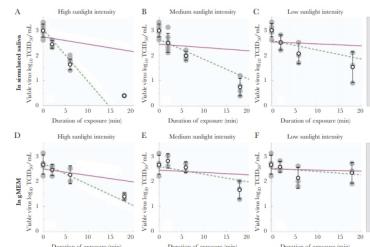
In work that has appeared in the Journal of Infectious Diseases, Paolo, Yangying and collaborators have shown that SARS-CoV-2 is inactivated by sunlight at a rate that is an order of magnitude faster than predicted by established theories.

In 2017, UC Santa Barbara mechanical engineer Paolo Luzzatto-Fegiz and colleagues published a paper in the Proceedings of the National Academy of Sciences explaining that they had solved a mystery in fluid flow. Now, he has been awarded a prestigious CAREER Award from the National Science Foundation to develop a theory of the phenomenon. In addition, he and UCSB mechanical engineer Frederic Gibou, along with collaborators at the University of Manchester, have received a joint US-UK grant to extend their work to high-speed, turbulent flows.

Recently, the Hawkes group was featured on the YouTube channel Veritasium with their a vine robot project and the video has over 7 million views so far!

When we hear the word “tsunami,” we think immediately of the widespread devastation that can result from these uniquely powerful waves. The tsunamis we hear about most often are caused by undersea earthquakes, and the waves they generate can travel at speeds of up to 250 miles per hour and reach heights of tens of meters when they make landfall and break, causing massive flooding and rapid widespread devastation in coastal areas, as happened in Southeast Asia in 2004 and in Japan in 2011.