Research

A paper published June 15 in the Proceedings of the National Academy of Sciences (PNAS) and co-authored by Beth Pruitt, UC Santa Barbara professor of mechanical engineering and director of the UCSB Institute for BioEngineering, describes the results of a complex long-term collaboration that has included researchers at Stanford University, the University of Washington, and the University of Kentucky. The study has led to new understanding of how genetic mutations play out at the cellular level to cause HCM, and new perspectives on how to prevent it

Three projects that take innovative approaches to solving critical energy-efficiency challenges have been awarded seed funding from UC Santa Barbara’s Institute for Energy Efficiency (IEE), an interdisciplinary research institute committed to improving energy efficiency. The selected projects align with at least one of the institute’s three key interdisciplinary thrusts: smart societal infrastructure, computing and communications, and the food-energy-water nexus. Each proposal will receive up to $50,000 in critical seed funding, which is intended to produce preliminary results that the scientists can use to apply for major external funding to expand their research.

Megan Valentine, a professor of mechanical engineering and co-director of the California NanoSystems Institute at UC Santa Barbara, has been awarded a $1.8 million collaborative grant by the National Science Foundation to design and create next-generation materials inspired and empowered by biological cells. Valentine will be working alongside a team of physicists, biologists and engineers, four of whom are women
A postdoctoral researcher in the lab of Alban Sauret, an assistant professor of mechanical engineering, has won the prestigious Milton van Dyke award for best video in the Annual Gallery of Fluid Motion, presented by the Division of Fluid Dynamics (DFD) at the 74th annual meeting of the American Physical Society.

A Granular Understanding Engineers describe how fluid suspensions exhibit different behaviors at different scales

A mechanical jumper developed by UC Santa Barbara engineering professor Elliot Hawkes and collaborators is capable of achieving the tallest height — roughly 100 feet (30 meters) — of any jumper to date, engineered or biological. The feat represents a fresh approach to the design of jumping devices and advances the understanding of jumping as a form of locomotion.
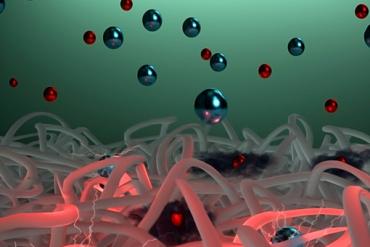
For decades now, field-effect transistors enabled by silicon-based semiconductors have powered the electronics revolution. But in recent years, manufacturers have come up against hard physical limits to further size reductions and efficiency gains of silicon chips. That has scientists and engineers looking for alternatives to conventional metal-oxide semiconductor (CMOS) transistors.
The delicate fragrance of jasmine is a delight to the senses. The sweet scent is popular in teas, perfumes and potpourri. But take a whiff of the concentrated essential oil, and the pleasant aroma becomes almost cloying. Indeed, part of the flower’s smell comes from the compound skatole, a prominent component of fecal odor.

Sometimes, the most complex problems can be solved with the simplest approaches. Such was the case for researchers at UC Santa Barbara as they tried to resolve a longstanding issue of fluid friction — the resistance between an object moving through fluid, or conversely, a stationary object with fluid flowing around or through it. It’s also known as drag.