In the News
Sakkmesterke vi Adobe Stock
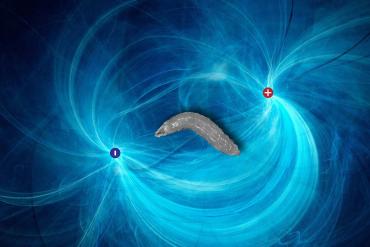
Fruit fly larvae will reorient themselves toward the negative pole of an electric field.
While it may be an unfamiliar sensation to humans, electroreception is relatively commonplace in the animal kingdom. Sharks, bees and even the platypus all share this ability to detect electric fields in their environment.
Scientists at UC Santa Barbara have just added fruit flies to that list. A team of researchers led by Matthieu Louis found that fruit fly larvae can sense electric fields and navigate toward the negative electric potential using a small set of sensory neurons in their head.
Tyler Lastovich / Unsplash
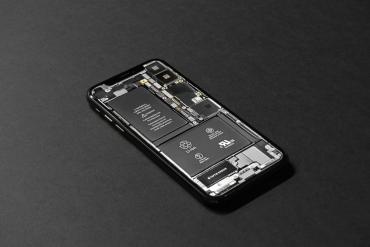
Lithium-ion batteries power everything from cell phones to laptops
Lithium-ion batteries today are nearly ubiquitous, powering everything from cell phones to laptops. Small wonder, then, that scientists are continually trying to develop safer and more energy-efficient battery technology.
A research collaborative including UC Santa Barbara materials and mechanical engineer, battery expert Jeff Sakamoto, recently revealed key insights into solid electrolytes being tested for use in all-solid-state batteries.
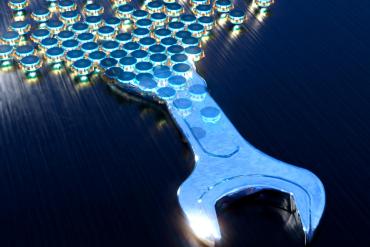
Disk-shaped robots can act collectively to accomplish tasks such as lifting and manipulating objects, or supporting weight
Researchers at UC Santa Barbara and TU Dresden are blurring the lines between robotics and materials, with a proof-of-concept material-like collective of robots with behaviors inspired by biology.
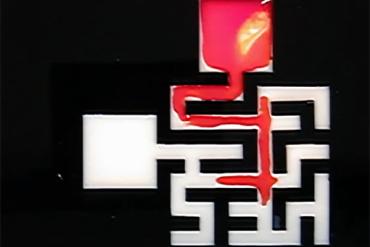
Seven years ago, UC Santa Barbara researchers caught an unexpected phenomenon on film: A pool of red dye that somehow “knew” how to solve a maze filled with milk. Propelled forward by a couple drops of soap, it unerringly found its way, avoiding dead ends and even making 90 degree turns in its path toward the exit.
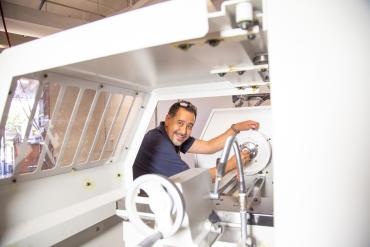
Donors, faculty, students and staff recently celebrated the opening of the modernized space
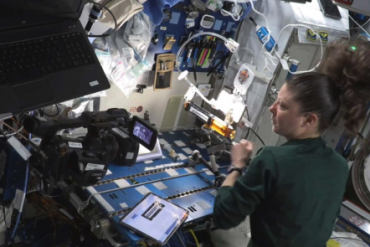
Emilie Dressaire, an assistant professor in the UCSB Mechanical Engineering Department, had an intimate look at the International Space Station (ISS) last year, spending time inside it via Zoom as she worked with an astronaut to fix a problem with one of nine onboard experiments she had sent to the ISS.
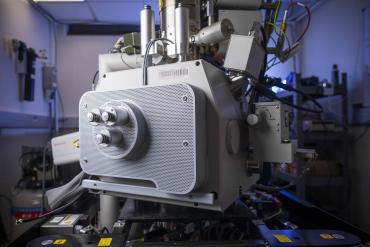
The Bolin Liao lab has achieved the first-ever “movie” of the phenomenon.
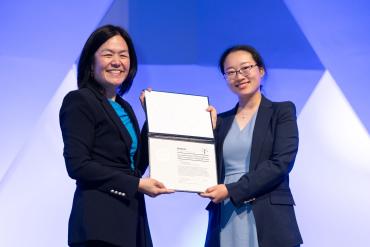
Mechanical engineer Yangying Zhu is among the first 13 academics to receive the inaugural IGNIITE grant
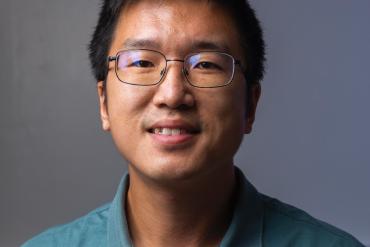
Team led by Bolin Liao has been awarded a $1.9M NSF grant on "AI-Enhanced Material-Device Codesign of Boron Arsenide as the Next-Generation Semiconductor".
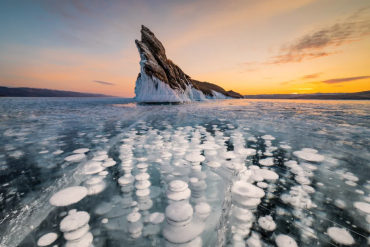
As water freezes, most of its dissolved gases get expelled. But some tiny bubbles near the freezing edge can get trapped in the solidifying ice, where they keep growing. Virgile Thiévenaz, who studies fluid mechanics at Paris’s Industrial Physics and Chemistry Higher Education Institute, and Alban Sauret, a mechanical engineer at the University of California, Santa Barbara, re-created this process in the laboratory to tease apart the factors that affect growing bubbles’ shapes and sizes.