An investment from the W. M. Keck Foundation is helping UC Santa Barbara researchers push forward with ambitious, high-impact work across science and engineering—advancing discoveries that could reshape fields ranging from materials science to climate research.
Through the foundation’s Bridge Funding Initiative, UCSB has been awarded $1.2 million to support six innovative research projects led by early- and mid-career faculty and their graduate students. The program is designed to accelerate promising ideas at critical stages, enabling researchers to sustain momentum and pursue transformative breakthroughs. At UCSB, the selected projects reflect the university’s strength in interdisciplinary collaboration and its commitment to advancing fundamental science with real-world potential.
“We are deeply grateful to the W.M. Keck Foundation for its continued partnership with UCSB and for recognizing the importance of supporting bold, early-stage research,” said Rachel Segalman, vice chancellor of research and professor of materials and chemical engineering. “Supporting our faculty and students is essential to advancing discovery and enabling them to pursue ideas that can open entirely new directions in science and engineering.”
Visualizing the Mechanics of Gene Control
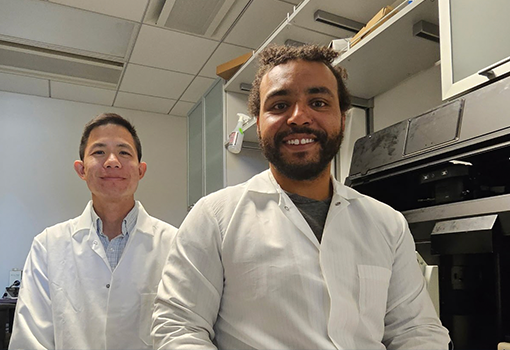
Enoch Yeung, an associate professor of mechanical engineering, and PhD candidate Aleczander Taylor are developing a first-of-its-kind system to observe how DNA physically behaves during gene activity, making visible processes that have long been inferred but never directly seen.
Their project centers on a single-molecule imaging platform that tracks how CRISPRi proteins interact with DNA and influence its mechanical properties, including twisting and supercoiling. While CRISPR is widely known as a gene-editing tool, Yeung’s team is uncovering a deeper layer of biology, one in which physical forces shape gene expression.
“For nearly twenty years, researchers in the field have gotten faster and faster with creating and editing synthetic DNA,” Yeung said. “In 2025, my group conducted a study that allowed us to visualize how gene editing affects the topology of DNA. We found that gene editing distorts how DNA twists, like how a stone thrown into a pond creates ripples. This project seeks to understand whether and how CRISPRi proteins alter that ripple landscape.”
DNA topology refers to how DNA is physically arranged, how it twists, coils, and folds in space, much like a telephone cord that can became tightly wound or loosely relaxed. Those physical changes aren’t just structural; they can influence how genes turn on and off.
“When genes are expressed, those strands are unwound and the twist is spread to other portions of the DNA,” he said. “Mechanical, torsional stress from twist is a real signal that creates measurable changes in gene expression.”
After five years of development, Yeung’s lab, led by postdoctoral researchers Lili Yang and Yanran Wang, built an experimental system capable of stretching and imaging individual DNA molecules while tracking gene activity in real time, something Yeung says “has never been done before.”
For Taylor, a fifth-year PhD candidate, the ability to directly observe these interactions marks a turning point in the research.
“One of the frustrating aspects of working with molecular biology as an engineer is not being able to see the mechanisms at work,” he said. “The ability to visualize these DNA-protein interactions… allows us to create a more complete understanding of processes we were previously blind to.”
Early findings are already reshaping how scientists understand gene regulation. The team has observed that DNA twist can become highly localized by the activity of RNA polymerases, forming tightly wound regions that can activate or repress nearby genes.
By revealing how mechanical forces propagate along DNA, the research could change how scientists design gene therapies and synthetic biology systems, moving toward more predictive control of gene expression.
“I hope that my work will expand our understanding of how bacteria make complex control decisions and ultimately provide us with new ways of programming them to produce useful outcomes,” Taylor said.
The Keck Foundation’s support comes at a pivotal moment, providing critical stability for both the research and the researchers behind it.
“We will be able to perform single-molecule imaging studies of CRISPR and DNA topology that no group has ever attempted before,” said Yeung. “We are tremendously grateful for the innovative, high-risk, and high-reward experiments we can pursue with the Keck Foundation’s support.”
“Receiving this funding has given me the stability to pursue the kind of fundamental, high-risk science that defines an impactful PhD experience,” Taylor added.
Other UCSB teams selected for Keck Bridge grants include Elaheh Ahmadi and Navid Kafi in electrical and computer engineering, Brooke Gardner and Soham Chowdhury in molecular, cellular, and developmental biology, Gen Li and Fan Liu in earth science, Angela Pitenis and Katy Dilley in materials, and Elizabeth Wilbanks and Victoria Jones in ecology, evolution, and marine biology. Learn more about those projects here.
About the W. M. Keck Foundation
The W. M. Keck Foundation was established in 1954 in Los Angeles by William Myron Keck, founder of The Superior Oil Company. One of the nation's largest philanthropic organizations, the W. M. Keck Foundation supports outstanding science, engineering and medical research. The Foundation also supports undergraduate education and maintains a program within Southern California to support arts and culture, education, health and community service projects.