Research

UCSB’s Emilie Dressaire receives an NSF CAREER award to study transport in microgels that may help cancer research.

UCSB engineering team receives inaugural award to design reusable systems for spacecraft returning to Earth.

Associate professor Enoch Yeung and PhD candidate Alec Taylor are developing a first-of-its-kind system to observe how DNA physically behaves during gene activity.

The leading-edge technology makes on-chip micro-fabrication possible.

The mission of a new nonprofit is to overcome barriers to developing prototypes and moving them to industrial-scale production.

New Master of Engineering and Technology Leadership (METL) program expands access to UCSB’s world-class engineering education for working professionals worldwide.
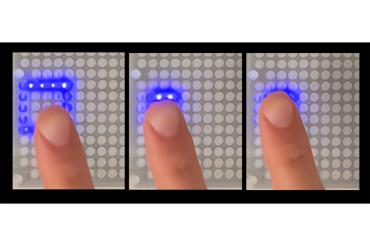
Researchers at UC Santa Barbara have invented a display technology for on-screen graphics that are both visible and haptic, meaning that they can be felt via touch. The screens are patterned with tiny pixels that expand outward yielding bumps when illuminated, enabling the display of dynamic graphical animations that can be seen with the eyes and felt with the hand. This technology could one day enable high-definition visual-haptic touch screens for automobiles, mobile computing, or intelligent architectural walls.

Researchers will work toward improving efficiency in electric motors, quantum computing, and large language models with IEE support.
A seaweed-derived gel that helps scientists understand how cells grow in their environment could be used for breast cancer research.
A new study finds that adding certain dopants could lead to safer, more energy-efficient batteries.