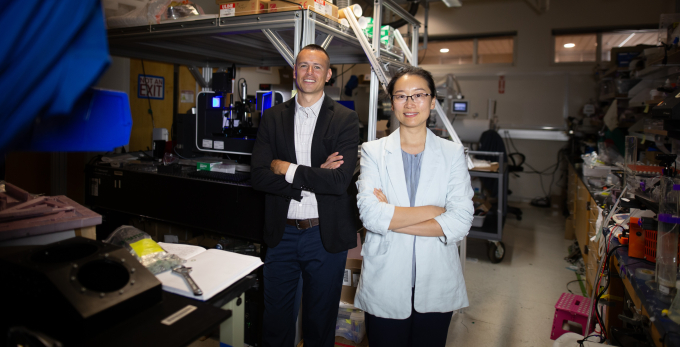
UC Santa Barbara engineering faculty members Daniel Oropeza and Yangying Zhu are exploring that possibility through a new type of thermal protection system, or TPS, made from a heat-resistant porous metal infused with a polymer. The researchers recently received $200,000 from the Alliance of Hispanic Serving Research Universities (HSRU) to investigate a TPS that could withstand multiple space flights, protecting spacecraft returning to Earth from the heat of re-entry.
Their project, Next Generation Thermal Protection Systems: Developing Advanced Metal-Polymer Composites for Reusable Spacecraft, is one of fifteen selected for HSRU’s inaugural ASCENDᴿ (Advancing STEM Careers through Education, Networking, and Development plus Research) Research and Leadership Program. Each project is focused on research topics that align with the U.S. Department of Defense’s science and technology priorities. The program itself aims to encourage collaboration among the twenty-four research-focused Hispanic-serving institutions that HSRU works with and give graduate students opportunities in applied research.
As part of the program, Oropeza, an assistant professor of materials, and Zhu, an associate professor of mechanical engineering, will participate in HSRU’s leadership program and add one graduate student to their research team.
The project brings together complementary expertise. Zhu contributes a background in thermal engineering and thermal mechanics, while Oropeza will focus on designing and manufacturing the materials that form their protection system.
“The challenges within materials and manufacturing problems for aerospace are interesting because they're difficult,” Oropeza said.
Along with the promise of challenges, Oropeza and Zhu are also hoping their work connects to a larger purpose. "Space exploration, for me, is very inspiring, but also I think it brings humanity together," Oropeza said. “We all look up and want to think about what’s out there.”
That sense of wonder meets a very real engineering challenge when spacecraft return to Earth.
Read full article at Robert Mehrabian College of Engineering here