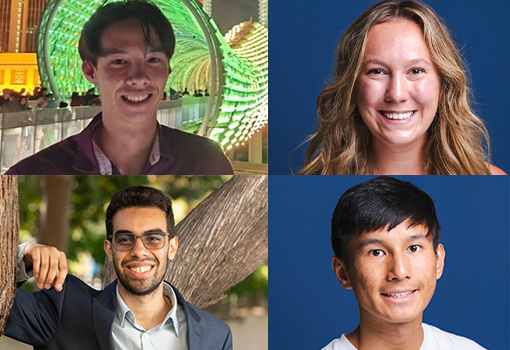
Three PhD students and one master’s student in UC Santa Barbara’s Mechanical Engineering Department are among the nearly thirty students affiliated with The Robert Mehrabian College of Engineering (COE) to receive the National Science Foundation (NSF) Graduate Research Fellowship, one of the most competitive honors in STEM.
The NSF awarded more than 2,500 fellowships for the 2026-27 academic year from nearly 14,000 applicants. The program provides three years of financial support over a five-year period, including a $37,000 annual stipend and a $16,000 cost-of-education annual allowance, totaling $159,000.
“The NSF GRFP is one of the clearest indicators of future leadership in science and engineering,” said Umesh Mishra, dean of The Robert Mehrabian College of Engineering. “Seeing so many of our students recognized at this level speaks to the culture of innovation, rigor, and collaboration that drives discovery at UC Santa Barbara, both at the graduate and undergraduate levels, and impacts the global economy.”
This year’s recipients from COE include fourteen current students, at least eight incoming PhD students, and six alumni who are now pursuing graduate degrees at other institutions.
Hear what the NSF Fellowship means to the four current mechanical engineering graduate students, Christopher Koh, Karlee Macaw, Andres Torres, and Christopher Xu.
Christopher Koh, Mechanical Engineering PhD student
A first-year PhD student, Christopher Koh is exploring the intersection of control theory and machine learning to advance safer, more reliable intelligent systems. Advised by Francesco Bullo, his work focuses on integrating the mathematical rigor of control theory with the flexibility of machine learning, an approach aimed at improving performance in safety-critical applications such as robotics, aerospace systems, and power grids.
While machine learning offers powerful new capabilities, its lack of reliability in high-stakes environments remains a key limitation. Koh’s research seeks to address that challenge, developing methods that can meet the demands of real-world deployment where precision and dependability are essential.
Receiving the prestigious NSF Fellowship provides both validation and stability early in his graduate career. “Securing funding in the current environment at the federal level provides a large sense of relief,” Koh said. “This allows me to focus more fully on my research and degree requirements, and to pursue work that aims to make these systems more flexible, safe, and reliable.”
Karlee Macaw, Mechanical Engineering master’s student
Karlee Macaw, a first-year master’s student advised by Ryan Stowers, studies how cells respond to the mechanical properties of their environment, with implications for diseases such as cancer and fibrosis.
Macaw describes the fellowship as a pivotal milestone in her academic journey. “It validates the work I’ve committed to and makes pursuing a PhD focused on mechanobiology research a real possibility,” she said, noting that it provides the freedom to focus on impactful research.
Andres Torres, Mechanical Engineering PhD student
A first-year PhD student advised by Elliot Hawkes and Tobia Marcucci, Andres Torres is developing autonomous capabilities for soft robots designed to safely interact with humans, similar, Torres says, to “Baymax from the movie, Big Hero 6.”
Torres describes the award as both a personal milestone and a reflection of strong mentorship at UCSB. “Receiving the NSF Fellowship means so much to me,” said Torres. “I definitely would not have won this without the amazing resources and faculty here at UCSB, especially my advisors. This fellowship will enable me to pursue my dream of working on robotics research!”
Christopher Xu, Mechanical Engineering PhD student
Christopher Xu, a first-year PhD student advised by Elliot Hawkes, develops highly agile robotic systems capable of navigating complex environments, with applications in exploration and environmental monitoring. For example, he is working on a robot that jumps into trees like a squirrel.
Xu says the fellowship allows him to fully immerse himself in research. “I can focus entirely on research, which is what I came here to do,” he said, adding that the support gives him the freedom to explore ambitious ideas that might otherwise be difficult to pursue. “I love the work that I do in the lab like a hobby, and I am grateful to be able to do it with so much flexibility.”