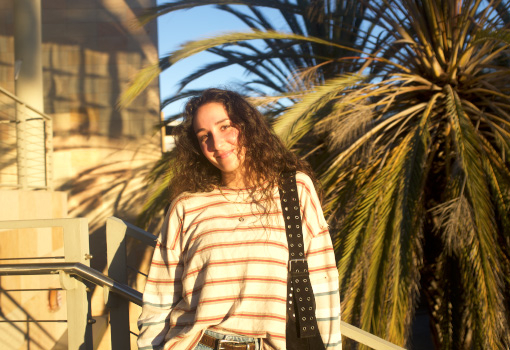
When a military tank rumbled through the narrow lanes of her Lebanese hometown, flattening roadside vegetation in its path, seven-year-old Shantal Adajian stood defiantly before it. “I will not let you pass,” she announced to the soldiers she knew were sitting in the tank. As her tiny frame blocked the road, in an attempt to guard the apricot tree she had planted on the roadside with her father and brother, she watched as the tank halted. Amused at the sight of this young girl blocking their way, the soldiers climbed out, expecting to scare her off — only to realize she wasn’t playing around, but rather, protecting something she loved.
The soldiers apologized, and the next day returned with a basket of apricots for Adajian’s family — an offering to recognize the fearless child who had stood her ground.
That moment captures the essence of Adajian: brave, principled, and unyielding. Today, as a fourth-year PhD candidate in the Mechanical Engineering Department at UC Santa Barbara, she channels that same spirit into her research as a member of the Transport for Energy Applications Laboratory (TEALab), led by associate professor Bolin Liao.
Adajian is working to improve cooling in, and add longevity to, electronic devices by uncovering how mechanical stress affects heat flow, and translating those insights into design principles that industries can use. Acknowledging her contributions, Liao says, “Shantal’s research stands at the intersection of precision engineering and sustainability, helping to build energy systems that are not only more efficient but also more resilient — paving the way for a cleaner future.”

Adajian’s drive to work with energy systems stems from the realities she faced growing up in Anjar, a small town near the Syrian border. Anjar, a contraction of the Arabic ‘Ayn al-Jarr’, means “water from the rock,” and for generations, a life-sustaining system of gravity-fed pipes has brought water down from the mountains to Anjar and the neighboring villages.
But for Adajian, who lived at the highest point of the town, access to water was never guaranteed. “We didn’t get clean water every day,” she recalled, noting that the village also regularly went without electricity. “In fact, we had maybe three or four hours of electricity a day, so we had to be careful with how we used our resources.”
Those daily struggles left a deep mark. “It felt insane that our basic survival needs weren’t met,” she says. “Anjarians are descendants of genocide survivors — people who escaped unimaginable horrors — so, despite their resilience and strength, there’s this collective belief that whatever we have now is enough, even if it’s not fair or sustainable. But I always felt we deserve better.
The conviction that access to clean water and reliable energy is not a privilege but, rather, a fundamental right became the cornerstone of her purpose as a researcher, fueling her determination to help build a future in which communities everywhere can depend on stable, efficient, and sustainable energy systems.
To fully understand Adajian’s journey requires taking a look at the girl who grew up in a place where bombings were a weekly occurrence, the line between enemy and friend was thin, and sheltering refugees in your home was a fact of life.
Despite those harsh realities, and living in constant fear, Adajian laughed when she described her younger self. “I was a very rowdy kid — a total menace growing up,” she says. In her hometown, she was known not only for her energy but also for defying expectations. “I was probably one of the few females who hunted. Every day I would wake up early to go hunt with my dad. My parents didn’t care much for gender roles, and encouraged me to be myself.”

Even as the “rowdy one,” Adajian excelled in her studies. “I was always first in my class,” she says proudly. She stood out in school for her aptitude in math and physics, having realized early on that logic and problem-solving were her forte. The resources to explore these passions beyond the standard school curriculum, however, were scarce, with few physics or math books available. A chance encounter with a book lying in a dusty corner of the library changed things for Adajian.
It was Michio Kaku’s Hyperspace: A Scientific Odyssey Through Parallel Universes, Time Warps, and the 10th Dimension. “I read it. I didn’t understand anything,” she recalls, “and that’s when I realized how badly I wanted to understand everything.” That mixture of frustration and fascination became a catalyst, compelling her to pursue engineering sciences, even though she didn’t know what engineering was. Then an “angel” — the term Adajian uses for all those who have helped her on her way to becoming the first person in her family to attend college — dropped by for dinner.
A distant uncle came for a visit and, impressed upon hearing of Adajian’s top academic performance, explained to her what engineering is and encouraged her to pursue it. He then went on to fund her entire first year of college at the American University of Armenia (AUA).
Prior to attending university, Adajian’s life in Anjar had been rooted in community, routine, and the occasional trip up the mountains to converse and meditate with the monks who lived there, so she longed to experience how life outside of Lebanon would be. She was disappointed to find that women in Armenia were as repressed as in her country. As one of only three women in her engineering class, she attended classes in lecture halls dominated by men and often encountered expressions of misogyny, including dismissive comments and openly expressed doubts about her abilities, which cast a shadow over her experience. But she continued, determined to get the Bachelor of Science degree from the Zaven and Sonia Akian College of Science and Engineering (CSE). And while she had hoped to escape the shadow of the war in which she had grown up, when the Second Nagorno-Karabakh War broke out between Armenia and Azerbaijan, Adajian had to return home for safety.
At that time, she was working on a few undergraduate projects, including a life-cycle assessment of solar panels. Back home, she set up solar panels in her backyard and investigated how a combination of efficiency-enhancing systems such as tracking, which involves having the panels follow the movement of the sun for maximum exposure; cooling, to reduce heat-related efficiency loss; and cleaning, to remove dust and debris affected panel performance.
Adajian found research exciting but had no idea that one could pursue it as a profession, until another “angel,” this time a cousin, visited and advised her to apply for a PhD in the United States. “I didn’t even know what a PhD was, or that you could get paid to study! That was news to me,” Adajian recalls. She got to work, cleared the required exams, and — with one cousin helping her fill out the applications and another covering all the fees, submitted ten applications over ten days. She received five acceptances with UCSB as her top choice.
Now all she needed was a ticket to the U.S., which she could not afford. Undeterred, she found a short-term paid internship position, and within three months had the savings for a one-way ticket to California.
“My mentor, Professor Liao, really took a chance on me,” she explains. “He has given me clear guidance and the tools to grow. He pairs technical rigor with genuine care. He checks in on my family abroad and encourages me to get involved on campus. His mix of optimism and constructive critique have shaped me into a more resilient, curious, and independent researcher. I’ve learned from him that good science isn’t just about precision; it’s also about perseverance and balance.”
At the TEALab, Adajian is focused on understanding how strain impacts heat flow in materials. “When most people think about controlling how materials behave, they imagine using light, or electric or magnetic fields,” she says, “but for me, the real magic lies in strain — the stretching or compressing of a material.”
Early in her research, Adajian realized that strain can act as a powerful “control knob” for tuning how heat moves through materials. This is especially important for semiconductors, where managing heat is a constant challenge. Her focus is gallium nitride (GaN), the workhorse of high-power devices like LEDs, lasers, power amplifiers, and high-voltage switches, and a material in which UCSB is the world leader. These devices are subjected to repeated heating and cooling cycles in real-world use, which puts them under stress and affects their performance and reliability.
To study how strain impacts the thermal conductivity of GaN, researchers need precise in-situ measurements. But those are difficult to perform because GaN is stiff and brittle, making it extremely hard to handle and stretch without breaking or introducing errors.

Inspired by a custom strain approach pioneered by researchers in South Korea and the United Kingdom, Adajian developed the sample-handling and loading process and used a uniaxial loading stage to safely strain thin, fragile GaN. She then integrated that process with thermal and structural probes, measured heat flow, and used spectroscopy and X-ray diffraction to track strain and crystal quality. “It’s a blend of fundamental science and meticulous craftsmanship, which involves polishing tiny GaN samples to about fifteen microns [our eyelashes are around sixty microns], then stretching them just enough to reveal how the invisible world of heat truly works,” she explains
Adajian’s new way to control heat flow in a fragile semiconductor material could lead to better, more reliable high-power electronics and energy devices.
Adajian’s journey has been one of courage, conviction, an unshakable belief in possibility, and drive. At UCSB, she has found both a scientific purpose and a peaceful environment. “I love how connected the campus is to nature,” she says, “I enjoy birdwatching at Ellwood, running on the bluffs, gravel biking, and hiking. The hummingbirds outside my window still blow my mind; they feel like pure magic.”
Looking ahead, Adajian hopes to channel her expertise into building resilient energy systems for communities like the one where she grew up. “If I can help make life a little more stable, a little more fair,” she says “then everything I’ve learned will have been worth it.”